Why ventilation matters even with low-VOC paints
Low-VOC paints reduce the total mass of volatile compounds applied to a surface, but they do not eliminate emissions entirely. Even products with VOC content of 1–5 g/L will release some vapour as the film forms and cures. In a poorly ventilated room — common in older Polish residential buildings without mechanical ventilation — even small quantities of VOC can accumulate above guideline concentrations during the initial application phase.
Beyond VOCs, interior painting generates other airborne components: fine paint mist during roller application, ammonia from waterborne systems (even at low concentrations), and dust from surface preparation. Adequate ventilation addresses all of these, not only regulated VOC emissions.
Practical ventilation requirements are therefore not scaled solely to the product's VOC content. The room volume, number of coats applied, surface area, and ambient temperature all influence how quickly airborne concentrations return to acceptable levels after painting.
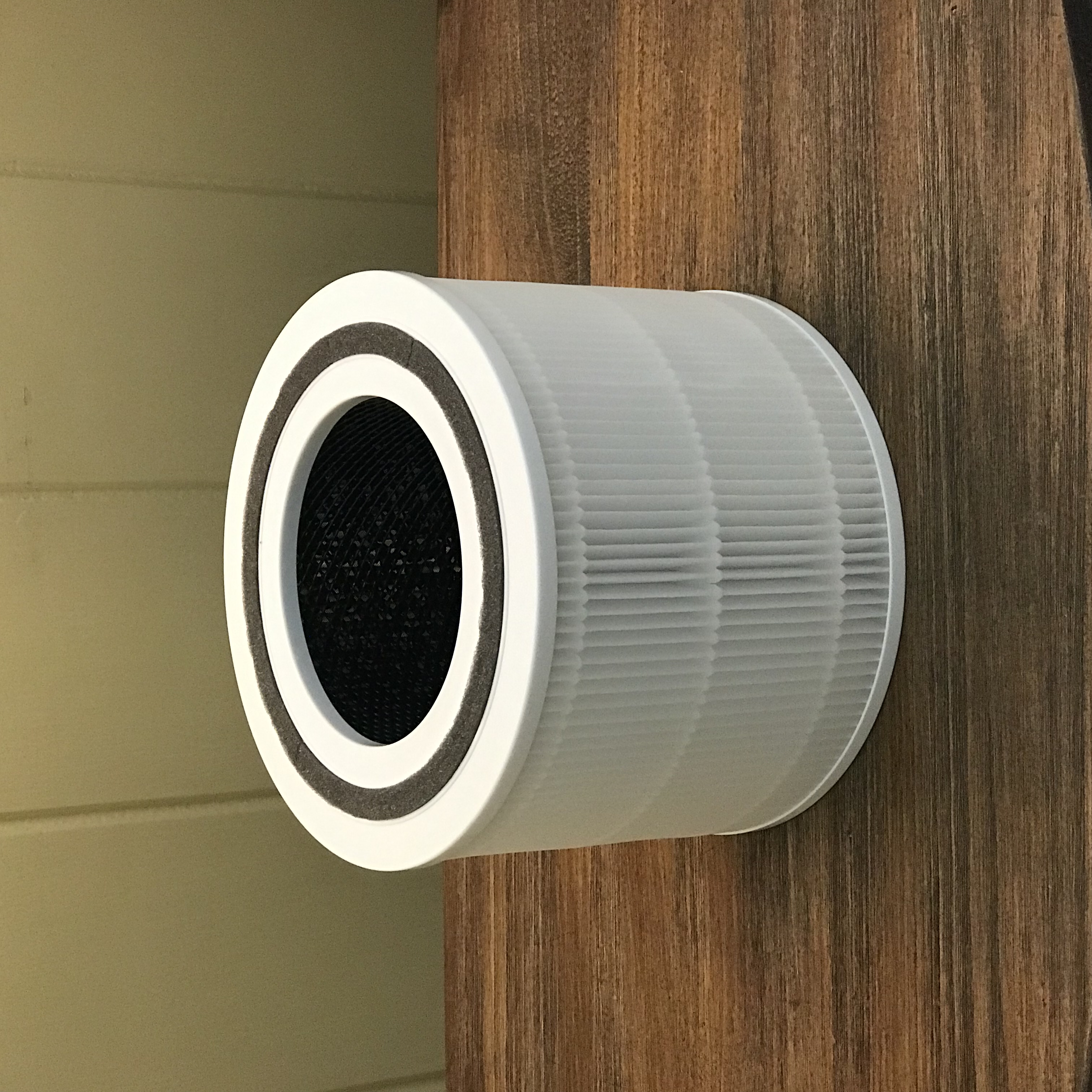
HEPA and activated carbon filter used in air purification. Licence: CC BY 2.0, Home Air Quality Guides / Wikimedia Commons.
Regulatory basis in Poland
Ventilation requirements for Polish buildings are set primarily through Rozporządzenie Ministra Infrastruktury w sprawie warunków technicznych, jakim powinny odpowiadać budynki i ich usytuowanie (Regulation of the Minister of Infrastructure on technical conditions for buildings and their siting), commonly referred to as the "Technical Conditions Regulation" (Warunki Techniczne, WT). This regulation specifies minimum air change rates for different room types in residential and commercial buildings.
For indoor painting works performed in an occupational setting, the relevant framework is Regulation of the Minister of Labour and Social Policy on occupational safety and health during painting work (Rozporządzenie w sprawie bezpieczeństwa i higieny pracy przy wykonywaniu prac malarskich). This regulation requires that workplaces be ventilated to prevent accumulation of flammable vapours and harmful concentrations of solvents and other chemical agents.
The Polish standard PN-EN 15251 (Indoor environmental input parameters for design and assessment of energy performance of buildings, addressing indoor air quality) provides criteria for acceptable indoor air quality and is used in professional building assessment contexts. It does not set painting-specific rules but establishes the air quality benchmarks that post-painting ventilation is designed to achieve.
Ventilation during the painting process
During application, the following minimum measures apply:
Window and door opening
The most accessible ventilation method in Polish apartments is cross-ventilation through open windows and doors. Opposite-wall openings create a through-draft that dilutes airborne emissions most effectively. During painting, windows in the room being painted should remain open unless conditions prevent it (e.g. rain, temperatures below 5°C — which also affects paint application quality).
Mechanical extraction
In spaces without adequate natural ventilation — basement rooms, corridors without external windows, bathrooms — temporary mechanical extraction fans should be used. The fan should exhaust air to the outside, not recirculate it within the building. For waterborne paints in normal residential rooms, a fan providing 3–5 air changes per hour is sufficient during application.
Occupant exclusion
Polish occupational health regulations require that persons not involved in the painting work, including residents, remain outside the painted area during application and immediately after. This is particularly relevant in occupied buildings where renovation is conducted room by room. Children and individuals with respiratory conditions should not be present during or immediately after painting regardless of the product's VOC classification.
Ventilation after painting: airing periods
The airing period — the time a space should be actively ventilated before normal occupancy resumes — depends on the product type, the number of coats, and the room volume-to-surface-area ratio. No single Polish regulation prescribes universal post-painting airing times; guidance is typically drawn from manufacturer TDS instructions and occupational health standards.
General guidance by product category
| Product type | Typical VOC range | Minimum airing period (active ventilation) |
|---|---|---|
| Waterborne wall paint, EU Ecolabel (<1 g/L) | 0–1 g/L | 24 hours with open windows |
| Waterborne wall paint, Cat A/a compliant (<30 g/L) | 1–30 g/L | 48–72 hours with active cross-ventilation |
| Interior trim paint, Cat A/c (<150 g/L) | 50–150 g/L | 3–7 days; professional guidance recommended |
| Solvent-borne products (if used) | >150 g/L | At least 7 days; occupational health assessment required |
These figures assume a standard residential room of 20–25 m² with 2.5–2.8 m ceiling height — typical dimensions in Polish apartment construction. Larger volumes with the same surface area require proportionally less airing time per unit area; smaller, enclosed spaces require more.
Air change rates in Polish building standards
The Technical Conditions Regulation specifies minimum air change rates for residential rooms in normal use. Habitable rooms (bedrooms, living rooms) require a minimum of 0.5 air changes per hour under normal occupancy. Kitchens and bathrooms have higher requirements due to moisture generation.
During painting, the target is substantially higher — typically 3–10 air changes per hour depending on VOC load. This cannot always be achieved through gravity ventilation alone, particularly in still-weather conditions common in Polish cities. On still days, mechanical fans or air movers are necessary to achieve adequate dilution.
After painting is complete and the room is unoccupied but ventilated, the objective is to reduce airborne VOC concentrations to below the WHO indoor air quality guideline concentrations before reoccupancy. The WHO Guidelines for Indoor Air Quality: Selected Pollutants (2010) sets specific guideline values for individual compounds such as formaldehyde, benzene, toluene, and others. These are not directly linked to the directive's aggregate VOC limit but provide a health-based framework for evaluating residual risk.
Practical ventilation methods in Polish residential settings
Polish apartment buildings vary significantly in ventilation infrastructure. Pre-1990 panel-construction buildings (bloki) typically rely on gravity stack ventilation through kitchen and bathroom exhaust grilles. These systems are designed for normal occupancy conditions and may be insufficient during painting.
Cross-ventilation through windows
Opening windows on opposite sides of an apartment creates through-draft. In a typical Polish apartment, opening bedroom and living room windows simultaneously with a kitchen or bathroom window open produces cross-flow. This is the most effective natural ventilation method and should be used during and for the first 24 hours after painting wherever weather permits.
Temporary mechanical fans
A standard 100 mm or 150 mm axial fan exhausting through a window opening is sufficient for most residential painting scenarios with low-VOC waterborne products. The fan should be positioned at the opposite end of the room from the incoming fresh air source. Recirculating air purifiers alone are not an adequate substitute for fresh air exchange — they filter particles but do not dilute solvent vapour or other VOCs effectively unless combined with activated carbon filtration.
Air purifiers with activated carbon
During the later curing phase (days 2–7 after painting), activated carbon air purifiers can supplement ventilation by adsorbing remaining trace VOCs. This is relevant in situations where windows cannot be left open continuously (security concerns, weather, noise). Activated carbon loses its adsorption capacity over time and should not be relied upon as the primary ventilation measure during active painting.
Special cases
Children's rooms and nurseries
Polish guidelines for interior spaces intended for children, including requirements referenced in Polish standards for kindergartens and nurseries, call for extended airing periods and verification that VOC levels have returned to acceptable concentrations before children reoccupy the space. In practice, this means a minimum of 72 hours of cross-ventilation after applying waterborne low-VOC products, and longer periods for any product with higher VOC content. EU Ecolabel products are often specified in renovation tenders for childcare facilities in Poland precisely because of their lower post-application emission profile.
Healthcare and sensitive facilities
Polish healthcare facility renovation standards (referenced in ministerial guidelines for hospital construction and renovation) require that VOC concentrations in patient-accessible areas return to baseline before reoccupancy. Professional environmental monitoring is typically required for renovation of occupied medical facilities.
Winter painting conditions
A practical constraint specific to Poland's climate is that painting in winter months (November–March) with outdoor temperatures below 5°C imposes limits on ventilation. Waterborne paints should not be applied at substrate or ambient temperatures below +5°C, and fully open-window ventilation is often not feasible. In these conditions, mechanical fans with fresh-air intake may be needed, and airing periods should be extended to account for slower solvent evaporation at lower temperatures.